
About
IMERS is a non-profit initiative established to develop and accelerate the implementation of a technically sound and politically acceptable global scheme to (1) raise financing to tackle climate change and (2) reduce shipping emissions, whilst recognizing the UNFCCC principle of common but differentiated responsibilities and respective capabilities.
The aim is to incorporate the scheme, preferably implemented as a levy on shipping emissions/fuel fuel with a rebate mechanism for developing countries, into the post-2020 climate agreement. IMERS will achieve this by: (1) undertaking policy analysis leveraging big data, and facilitation of submissions to the multilateral negotiations on the proposed scheme (2) developing a scheme demonstrator to illustrate the viability and operation of the proposed scheme, (3) mobilizing stakeholders, principally governments of both developed and developing countries, around the single supra-national scheme.
Why carbon pricing and why it's not implemented yet?
Carbon pricing of emissions from international shipping and aviation is attractive for two reasons. Firstly, it can provide the required incentive framework to cut emissions in these two fast-growing sectors where fuel is uniquely tax exempt. Secondly, it has the potential to provide up to $20 billion for climate change action, much of which can be transferred to developing countries.
The debate on carbon pricing has been dogged by disagreement on how (or even whether) to apply the principles of the UN Framework Convention on Climate Change (UNFCCC) in these inherently global sectors, in which regulations normally apply to all operators, irrespective of nationality. The shipping and aviation industries themselves back global regulation, arguing (rightly) that regulation at the local level will add costs to some operators but not others, distorting competition. However, many developing countries have raised concerns about uniform global policies due to their potential negative trade impacts and cost implications.
International Maritime Emission Reduction Scheme
This is proposed as a global, supra-national scheme under the governance of the IMO with an ambitious goal to halve shipping emissions over long-term.
IMERS in 30 words:A levy on fuel for international shipping with a Rebate Mechanism (RM) for developing countries. Applied worldwide, collected centrally - bypassing national coffers - raising $10bn+ annually for climate change action.
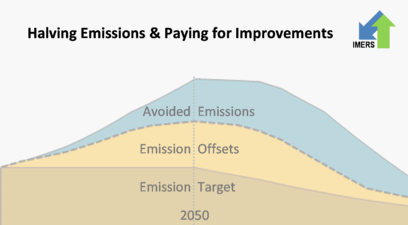
RM in 30 words (shipping): All ships pay for their emissions. A developing country obtains an annual rebate in relation to its share of global seaborne imports. Remaining revenue goes to climate change action, including in the sector.
RM can also apply to aviation.
- In other words, the proposal is to create a lowest cost scheme to reduce greenhouse gas (GHG) emissions from international maritime transport through a hybrid market mechanism combining:
 Near-term emission mitigation, including through forestry arrangements (REDD+)
 Technology fund focused on bringing forward technology transformations, such as hydrogen transport
 Funding for adaptation to climate change in developing countries.
A major redesign took place in 2010 through the implementation of a rebate mechanism submitted to the IMO, and supported by various stakeholders.
Summary details are available as:
- RM Aviation Fact Sheet
 (1.3 MB)
- RM Shipping Fact Sheet (1.1 MB)
 For queries and feedback please Contact Us Online. Alternatively please send email to: info [at] imers.org. For executive questions/proposals, please contact Dr Andre Stochniol at: andre [at] imers.org.