
Shipping Climate Architecture
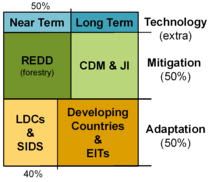 Architecture for Mitigation, Adaptation, and Technology Transformation for International Transport
  (0.4 Mb).
The architecture covers emissions from international maritime transport and potentially from aviation in the post-2012 climate agreement.
The potentially breakthrough GbD approach is introduced in section 4.1.5 Improving the Differentiation Further.
This was our approach tested with several governments from September 2008. Since Autumn 2009, a rebate mechanism for developing countries emerged as the preferred option (not described in the paper).
The main challenge addressed is how to provide global rules and policies for international transport while delivering on the principle of common but differentiated responsibilities embodied in the UNFCCC and the Kyoto Protocol. We propose to differentiate obligations and link together adaptation to climate change, emission mitigation, technology transformation, and financing in one single scheme. Differentiated emission charges will apply to reflect the climate change regime in force (currently differentiated by import for Annex I / non-Annex I).
The paper concludes:
- The deadlock to address emissions from international maritime transport can be resolved through the proposed architecture, balancing the interests of all parties.
- The proposed can be used to hammer out the maritime deal on the right political level - and in time for the key Copenhagen Climate Change Talks in 2009. Otherwise, the risk of inaction is twofold:
- repeat Kyoto’s failure to address international transport emissions, and
- fail to provide financing for adaptation to climate change crucially needed for the most vulnerable.
An abstract is provided below. The paper is structured as follows:
- The introduction discusses whether the existing policy deadlock presents an opportunity to address climate change in a holistic manner.
- Section 2 proposes six architectural principles which will be central to unlock common but differentiated responsibilities for international transport. It also quantifies benefits and costs to participating countries, and discusses equity issues.
- Section 3 builds a feasible instrument that could deliver the proposed architecture.
- Finally, Section 4 considers how the existing legal laws and precedents can enable early action.
Reconciling Positions - Solution for Annex I Parties
The option to narrow the architecture on the collection side to countries with emission reduction commitments - currently Annex I countries to the UNFCCC - is not fully covered in the paper. It is shortly discussed in section 4.1.5, Improving Differentiation Further.
Limiting the scope to Annex-I countries will reduce the total benefits to 60% from the numbers provided. Ships while transporting goods to Annex I countries will pay the emission charges, and while transporting goods to non-Annex I countries will not. Ships operating on mixed routes will pay 60% of the full fees, on average.
The need to reconsider such a less-efficient option has appeared after the recent first IMO Intersessional Meeting of the Working Group on Greenhouse Gas Emissions from ships in Oslo (IMO GHG WG 1). The session was tough, and the European Federation for Transport and Environment called it disappointing. It was not possible to bridge the principles of the IMO of providing global and uniform rules while delivering on the differentiated principles embodied in the UNFCCC and the Kyoto Protocol. As a result, it was not possible to further develop an economic instrument based either on the submissions for a levy/hybrid scheme or on submissions for an emission trading scheme (ETS).