
Achievements & Progress
Within relatively short time of 1 year from its creation the hybrid approach (aka IMERS) has achieved high recognition and support. The subsequent design and incorporation of a novel rebate mechanism made the scheme acceptable to developing countries. Selected progress is described in the reverse chronological order below (progress from autumn 2009 still needs to be added).
- Invitation and discussions at the 4th Latin America Carbon Forum, Panama; stakeholder mobilization; presentation Beyond Offsetting of Emission from International Transport
 (0.2 MB).
- Active participation at the Climate Change Talks 2009, in Bonn June, including a dedicated event on “Equitable Financing & Reducing Emissions from International Transport”; positive feedback & recommendations on next steps, including discussions how to modify paragraph 173d of the LCA negotiating text.
- IMERS is recommended in the Adaptation Report by the United Nations Foundation and the Club of Madrid. It is endorsed as one of three possible sources of new financing for climate adaptation that are "adequate, predictable, and sustainable". GLCA Report 2009: Adaptation to Climate Change (3.4 MB).
- In depth 3-week-long consultations in Washington, DC, USA (May 2009). Adjustment of the proposal to reflect the U.S. national circumstances and thereby increase its appeal. New Fact Sheet .
- IMERS presented at the World Ocean Conference, May 11-15, 2009, Manado, Indonesia. It was positively discussed at two policy panels on: (1) Addressing the “Climate Divide” and Promoting International Commitments and Funding Mechanisms [...], and (2) Properly Manage Mitigation Efforts that Use the Oceans. A policy brief is available on Oceans and Climate Change (1.9 MB).
- IMERS organization is granted an observer status at the UNFCCC.
- Detailed discussions and support from several developing countries at the UNCTAD expert meeting on "Maritime Transport and Climate Change Challenge". See: Submission , Presentation . Further details, including press coverage in Le Monde, and a final reportis available.
- We are invited to present how ICT can contribute to Global Sustainable Future. Audience grasps the proposal in 5 minute's presentation . Read more: Paradiso Conference.
- IMERS has proved its maturity at the COP 14 in Poznan, Poland, at:
- Our own side event entitled Common but Differentiated Responsibilities in International Transport; see the Message & Summary from the Event , and the Presentation (0.4 Mb)
- At the high-level roundtable on climate technology and finance organized by the GLCA
(the Global Leadership for Climate Action is a joint initiative of the United Nations Foundation and the Club of Madrid)
- The events and face-to-face discussions have secured more supporters for the proposal, including several high-profile statesmen. For additional details see @ Poznan: a breakthrough?
- Our own side event entitled Common but Differentiated Responsibilities in International Transport; see the Message & Summary from the Event
 Andre Stochniol, IMERS's founder Wins the Cool the Earth Idea Contest, Japan, 2008! He scoops the top prize in the Governmental System/Policy Division (overseas) for:
Creating and obtaining international support for differentiated International Maritime Emission Reduction Scheme to halve maritime emissions and pay for improvements. See more details.- The proposal is reviewed and/or proposed in reports prepared for COP 14, Poznan, Poland, including:
- UNFCCC official update on Investment and financial flows to address climate change; FCCC/TP/2008/7 (0.6MB); a shorter press summary is available as Fact sheet: Financing responses to climate change (0.3MB);
- Innovative Carbon-Based Funding for Adaptation (0.7MB), a briefing paper by the OECD for the 11th Meeting of the Africa Partnership Forum; the "final destination" version IMERS is described, alongside other proposals;
- Linking Emissions Trading Schemes for International Aviation and Maritime Emissions in a comprehensive research by Climate Strategies on Linkages among Emissions Trading Schemes; the 2008 GbD version of IMERS is described;
- Turning Carbon into Gold (0.4MB), a briefing paper by OXFAM on "How the international community can finance climate change adaptation without breaking the bank"; written by Heather K. Coleman in collaboration with David Waskow;
- International Shipping in a post-2012 climate deal (0.2MB), a background paper, Global Climate Policy, by WWF, by Peter Lockley, WWF UK;
- Adaptation under the UNFCCC: The road from Bonn to Poznan (0.9MB), a briefing paper by Germanwatch, authored by Sven Harmeling;
- Negotiations on additional investment and financial flows to address climate change in developing countries (0.4MB), by UNDP, authored by Erik Haites.
- UNFCCC official update on Investment and financial flows to address climate change; FCCC/TP/2008/7
- Professional Engineering Magazine writes on IMERS in an easy to understand way. See Cash on Delivery.
- IMERS proposal gets a good hearing in the UK parliament, at the influential Environmental Audit Committee. See: UK Parliament Testimony, includes a formal submission and testimony recording.
- Elements of IMERS are reviewed and proposed for the IMO MEPC 58 session, in:
- Independent report entitled "Left on the High Seas; Global Climate Policies for International Transport" by CE Delft, a member of research consortium working for the IMO on the update of the GHG 2000 study;
- Submission on Benefits and possible adverse impacts of market-based instruments, MEPC 58/4/39 (0.2MB), by WWF based on the above report;
- For more details see: GHG progress at MEPC 58.
- Independent report entitled "Left on the High Seas; Global Climate Policies for International Transport" by CE Delft, a member of research consortium working for the IMO on the update of the GHG 2000 study;
- IMERS is recommended for serious consideration in three reports for the Toyako G8 summit in July. They are:
- Globe International Adaptation Working Group (0.2MB), by working group chairs Mr. Anders Wijkman, MEP, European Parliament, Hon Suresh Prabhu, MP, Parliament of India, Lord Julian Hunt, UK House of Lords;
- Energy and Climate: Opportunities for the G-8 (1MB), research by Climate Strategies, prepared by Prof. Michael Grubb and 10 contributing experts;
- International Adaptation Finance (1.9MB): The Need for an Innovative and Strategic Approach, by Benito Müller, from Oxford Institute for Energy Studies.
- Globe International Adaptation Working Group
- Multiple Discussions @ Bonn Climate Change Talks (June): From 2-13 June maritime emissions featured most prominently in official discussions since anyone has remembered. They were discussed in all the four bodies meeting in Bonn at the SB 28. The proposed hybrid scheme was discussed several times by the parties. We also have run a site event dedicated to delivering "differentiated responsibilities" in a global scheme for shipping. The scheme will generate, inter alia, $4bn annually of financing for adaptation to climate change in developing countries (more details to follow, see also IMERS @ Bonn).
- Discussions @ UNFCCC (Bonn, April): The hybrid scheme has been discussed at the UNFCCC Workshop on Art. 9 KP - on the preparations for the second review of the Kyoto Protocol pursuant to its Article 9, Bonn, Germany (28-29 April 2008).
- Presentation by Norway, slides 6-7, (0.3MB), presented by Ms. Marit Viktoria Pettersen
- Presentation by Norway, slides 6-7,
- Discussions @ UNFCCC (Bangkok): The proposed scheme has been discussed at the UNFCCC 2008 meeting in Bangkok,Thailand (31 March - 04 April 2008). Number of parties were invited to present at the Thematic session 4 (out of 4) on: Greenhouse gases, sectors and source categories. Two parties responded, and in both presentations the maritime GHG hybrid proposal (aka IMERS) was prominently presented:
- Presentation by Norway, slide 7, (0.6MB), presented by Mr. Audun Rosland; available as a webcast (via agenda; 14 minutes)
- Presentation by the EU, slide 11-13, (0.3MB), presented by Mr. Jakob Graichen; available as a webcast (via agenda; 10 minutes)
- Follow-on Q&A and discussion on the main topics is available as a webcast (via an agenda link; 45 minutes). A summary from the session in included in a daily Earth Negotiations Bulletin (ENB) (0.2MB). For additional details are the final ENB summary from Bangkok (0.3 MB; see page 10).
- Presentation by Norway, slide 7,
- Submissions to the UNFCCC (Bangkok): The proposed scheme has been included in the views to the UNFCCC 2008 sessions in Bangkok, Thailand (31 March - 04 April 2008) of:
- AWG LCA 1 by Norway; see: FCCC/AWGLCA/2008/MISC.1 (0.6MB), Views regarding the work programme of the Ad Hoc Working Group on Long-term Cooperative Action under the Convention. Submissions from Parties. March 2008, pg. 54
- AWG 5 by Norway; see: FCCC/KP/AWG/2008/MISC.1 (0.5MB), Views and information on the means to achieve mitigation objectives of Annex I Parties, Submissions from Parties, March 2008, pg. 46-50
- AWG 5 by Slovenia on behalf of the European Union and its member states; see FCCC/KP/AWG/2008/MISC.1 (0.5MB), ibid, pg 74-76
- AWG LCA 1 by Norway; see: FCCC/AWGLCA/2008/MISC.1
- Submissions and discussions @ IMO MEPC:
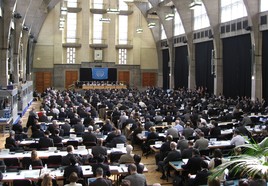
The proposed hybrid scheme is now seen as a short-term policy option; it has been included in some ways in three state submissions to the IMO MEPC 57 session in London, UK, 31 March - 04 April 2008:- MEPC 57/4/27 by South Africa, A hybrid market-based instrument for shipping to contribute fairly to climate change mitigation and adaptation (withdrawn from discussion at the session);
- MEPC 57/4/4 by Denmark (0.1MB), A global levy on marine bunkers, primarily to be applied for the acquisition of CO2 emission quotas through the purchase of CO2 credits;
- MEPC 57/4/5 section 5.11 by Australia and the Netherlands, Report of the Intersessional Correspondence Group on Greenhouse Gas Related Issues.
Note: I'm afraid the IMO submissions are not generally available (where they are the links have been provided). In some jurisdictions, such as in the USA, if you are a resident you can download them from the country maritime site. - Outcome of discussions: Both the hybrid scheme and the bunker fuel levy proposals have been positively discussed at the plenary and at the GHG Working Group. The proposal by Denmark (MEPC 57/4/4) was considered in more detail. Many delegations found this proposal promising. However, questions, concerns and doubts were raised that needed to be addressed. It was agreed that sufficient attention should be given to further develop this market based measure at the intersessional meeting in Oslo.
- Our official side event on Bunker Fuel Emissions and Adaptation Funding at the UNFCCC COP 13 climate change conference in Bali was very well attended (70 participants), including very senior climate change negotiators from major maritime states
- Other achievements/activities in Bali:
- IMERS was presented and discussed on an IETA side event entitled What is the scope for including international marine transport in the post-2012 regime?
- Norway gave credit to Dr Andre Stochniol as the creator of the idea and proposal on their side event (see Norwegian GHG proposal to IMO
 (0.2MB)); panellists noticed increased popularity of the concept as a day before Tuvalu had submitted a proposal to the COP on International Blueprint on Adaptation (0.2 MB) that anticipated a levy on maritime transport;
- Separate constructive discussions on IMERS with several representations (Dec 2007)
- IMERS was presented and discussed on an IETA side event entitled What is the scope for including international marine transport in the post-2012 regime?
- Two detailed submissions by Dr Andre Stochniol to the phase 1 and 2 of the IMO MEPC Correspondence Group on GHG related issues has helped at least one country to initiate their work on new submissions to the MEPC 57 in April 2007 on how IMERS, or similar schemes, could work in near-term from their point of view (Nov 2007)
- IMERS is brought up by a 3rd party (by Jasper Faber of CE Delft) and subsequently shortly discussed as a viable new global option at a policy seminar in Brussels entitled How to Make the Sea Green (Oct 2007).
- Low data requirements of IMERS are presented and recognized at the Technical workshop on Emissions from aviation and maritime transport, Oslo, Norway, 4-5 Oct 2007
- IMERS is the main topic for the panel on "Innovative financing and Environment" at the 3rd Plenary Meeting of the Leading Group on Solidarity Levies to Fund Development, Seoul, Korea, 3-4 Sept, 2007 (on invitation from the Foreign Office of Republic of Korea)
- Establishment of an intersessional IMO MEPC Correspondence Group on GHGs is credited to our concrete idea brought to the MEPC 56 and our preparatory activities with 30 countries (15 developed, 15 developing countries)
- Support of the idea at the 56th session of the IMO Marine Environment Protection Committee (MEPC) by the 27 EU countries and other 10 IMO member states, including Japan and Australia (July 2007)
- Official submission of the proposed concept by Norway to the IMO multilateral process as MEPC 56/4/9: Elements of a possible market-based CO2 emission reduction scheme (May 2007)
- Early recognition of IMERS novelty by maritime policy advisors initially from two and then four major maritime nations (March - April 2007)
Key presentations and documents are available separately.